"Large-scale" here refers not only to many nodes, but to many resources — like Jobs or ServiceMonitors.
Background
When extending Kubernetes cluster functionality, we often use k8s.io/client-go to interact with the Kubernetes API server, List/Watch resources, and do something. For example, kube-state-metrics Lists/Watches Pods, Deployments, Jobs, DaemonSets, etc., generates Prometheus metrics from resource data and exposes them for Prometheus to scrape. Prometheus Operator Lists/Watches ServiceMonitors, PodMonitors, etc., to update the Prometheus configuration file for scraping metrics.
k8s.io/client-go uses SharedIndexInformer to cache cluster resources in memory, reducing requests to the API server and easing its CPU/memory pressure. The catch: SharedIndexInformer first Lists all resources (e.g., all Jobs or all ServiceMonitors). If the cluster has a large number of resources, caching everything in memory can cause client memory usage to spike, risking OOM1 if limits are misconfigured or node resources are tight.
Mitigation Strategies
As client developers, we should optimize code to reduce memory usage. Here are several approaches I've gathered from reading Kubernetes component source code.
1. WithTransform
WithTransform trims objects by removing unused fields, like ManagedFields.
func WithTransform(transform cache.TransformFunc) SharedInformerOptionWithTransform places a TransformFunc in the Delta FIFO queue. Before objects are added to the queue (on List/Watch add/update/delete), they are trimmed — unused fields are stripped out, never cached in memory.
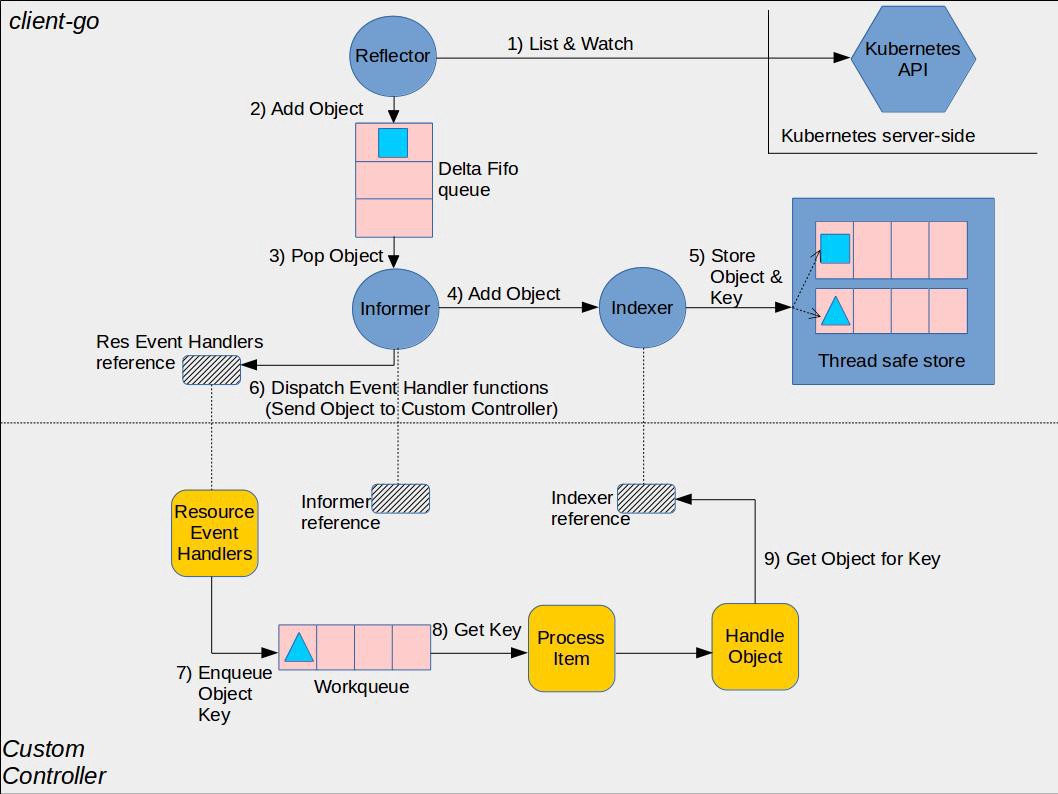
Image source: https://github.com/kubernetes/sample-controller/blob/v0.36.0/docs/images/client-go-controller-interaction.jpeg

For example, kube-controller-manager uses WithTransform to strip .metadata.managedFields from API server responses2:
trim := func(obj interface{}) (interface{}, error) {
	if accessor, err := meta.Accessor(obj); err == nil {
		if accessor.GetManagedFields() != nil {
			accessor.SetManagedFields(nil)
		}
	}
	return obj, nil
}
sharedInformers := informers.NewSharedInformerFactoryWithOptions(client, ResyncPeriod(s)(), informers.WithTransform(trim))
Implementation: https://github.com/kubernetes/kubernetes/pull/118455
2. Set ListOptions.ResourceVersion to "0"
When strong consistency isn't required, set ResourceVersion to "0" to read from the API server's watch cache. This improves performance and reduces etcd load, at the cost of potentially stale data.
As of Kubernetes 1.36, omitting ResourceVersion (or setting it to "") also reads from the watch cache but guarantees consistency.
Example from kube-state-metrics3:
if i.useAPIServerCache {
	options.ResourceVersion = "0"
}
Implementation: https://github.com/kubernetes/kube-state-metrics/pull/1548
More on Resource versions: Resource versions
3. WatchListCompression Feature Gate4
Enables gzip compression for WatchList requests. Enabled by default in Kubernetes 1.37+.
4. WatchListClient Feature Gate5
Enables the WatchList client on the client side to stream List responses instead of fetching in chunks. Enabled by default in Kubernetes v1.32 and v1.34+6.
genericfeatures.WatchList: {
	{Version: version.MustParse("1.27"), Default: false, PreRelease: featuregate.Alpha},
	{Version: version.MustParse("1.32"), Default: true, PreRelease: featuregate.Beta},
	{Version: version.MustParse("1.33"), Default: false, PreRelease: featuregate.Beta},
	{Version: version.MustParse("1.34"), Default: true, PreRelease: featuregate.Beta},
},
kube-apiserver and kube-controller-manager implementation: https://github.com/kubernetes/kubernetes/pull/132704
5. Set ListOptions.Limit
Configure Limit on List calls to cap the maximum number of objects returned per response. Note: if the WatchListClient feature gate is enabled, the Reflector in client-go will only make Watch calls.
kube-state-metrics implementation: https://github.com/kubernetes/kube-state-metrics/pull/2626
6. Set a Memory Soft Limit7
From Go's perspective, you can set a memory soft limit to tune GC frequency and release memory.
Three ways:
- Set the
GOMEMLIMITenvironment variable - Use runtime/debug.SetMemoryLimit at runtime
- Use the
github.com/KimMachineGun/automemlimitpackage to auto-detect cgroup memory limits and auto-setGOMEMLIMIT
kube-state-metrics auto-detection implementation: https://github.com/kubernetes/kube-state-metrics/pull/2447
Community Efforts
The Kubernetes community continues to optimize — including consistent reads from cache, streaming List responses, and server-side sharded List/Watch.
Related reading:
- Kubernetes v1.31: Accelerating Cluster Performance with Consistent Reads from Cache
- Kubernetes v1.33: Streaming List responses
- Kubernetes v1.36: Server-Side Sharded List and Watch
Summary
There are now many ways to reduce Kubernetes client memory usage — configuring ListOptions fields, feature gates, transform functions, and memory limits. The Kubernetes community continues to improve SharedIndexInformer and List/Watch calls.
References
-
https://github.com/kubernetes/kubernetes/blob/ecf6decece6a6de25a57aad9ba90b6ce580f6f78/cmd/kube-controller-manager/app/controllermanager.go#L531-L551 ↩
-
https://github.com/kubernetes/kube-state-metrics/blob/v2.19.0/pkg/watch/watch.go#L114-L116 ↩
-
https://github.com/kubernetes/enhancements/tree/master/keps/sig-api-machinery/3157-watch-list ↩
-
https://github.com/kubernetes/kubernetes/blob/ecf6decece6a6de25a57aad9ba90b6ce580f6f78/pkg/features/kube_features.go#L2353-L2359 ↩